Mt Washington - Final Day

We stayed at the Christmas Farm Inn and Spa last night.


Aaron these two pics are for you. I’ve never seen a skeleton and pumpkins on a fire truck and they’re hiring 😁.

The skeleton on top of the truck is really hard to see.

Leaving Jackson

I walked across the bridge so I could get some photos of the river. It seems like all the rivers we’ve seen have been really low.


We stopped for breakfast at a little cafe.

It was a lot of food.

Next stop was a visitor center to get a map of New Hampshire.


We drove up to Mount Washington, chug chug chugging all the way up in our little rental car.


You can take a cog train up if you don’t want to drive on the narrow road with sheer drop offs. Kim is checking out the engine. The following is a long story but very interesting if you want to know about the cog.
A nagging case of indigestion led to one of the greatest achievements of the Industrial Age
In 1857, not long after relocating to the Boston area, Chicago businessman Sylvester Marsh needed some exercise. Just two years earlier, he had left a successful career in the meat packing and grain drying industries behind, and had accumulated a personal fortune sufficient to guarantee a very comfortable retirement.
But boredom and chronic dyspepsia soon became intolerable, so one day in August of that year, along with his pastor, Marsh returned to his native New Hampshire to climb to the summit of Mount Washington. That hike would forever change his life, and it would then reach down through the years and touch the lives of countless others in the form of the Mount Washington Cog Railway.
When the two gentlemen set off that morning it was a beautiful summer day. But what happened once they were above tree line is what often happens on the mountain– Marsh and his friend suddenly found themselves in the midst of a life threatening storm. They pushed on, and just barely made it to the shelter of the Tip Top House with their lives. The bunker-like stone hostel was built on the summit in 1853, and remains to this day.
After what one can only imagine must have been a night of reflection on the day’s events (and hopefully a hot meal and a warm bed) Marsh came to the conclusion that there should be a safer and more efficient way for travelers to experience the grandeur of the mountain. He decided that he would be the man to make it happen, and being a modern man of his era, he would somehow use the state of the art transportation technology of his day, the steam locomotive.
But when he applied for a charter from the New Hampshire State Legislature in 1858 to begin the process of bringing his visionary project to life, he was nearly laughed out of the State House. They referred to him as “Crazy Marsh”, but awarded him the charter anyway, with the stipulation that once he reached the summit, he might as well keep going and build his “railway to the moon”.
But Sylvester Marsh would eventually have the last laugh.
Marsh knew that in order to make his railway feasible, he needed to solve many complex problems. Chief among them were his chosen route’s rugged terrain and its steep grade, averaging 25% and nearing 38% in some spots.
He solved the terrain problem by specifying that the three mile route would be built on an elevated trestle system, and that was probably one of the easier decisions he had to make. To this day, the Cog is the only railway in the world whose mainline tracks are built entirely above ground level.
It’s also the second steepest railway in the world, and maintaining traction on such steep grades would be unthinkable on a traditional railroad. It would take an entirely new concept to make it work.
The cog gear and rack were not Marsh’s invention, but the application of that technology to a mountain climbing railway certainly was. The idea is very much like the sprocket and chain on a bicycle. The teeth of the cog gears under the locomotive engage the rack, a spooled center track fixed to the cross ties between the running rails, and as the cog turns, the locomotive pulls itself forward.
Shortly after receiving his charter from the State legislature, Marsh was distracted by a lawsuit over property he owned back in Chicago. The dispute was successfully defended in 1860 by his able attorney, and happened to be Abraham Lincoln’s last court appearance prior to his election as the nation’s sixteenth president.
Construction progress was delayed by the American Civil War, so it wasn’t until 1866 that Marsh took delivery of the railway’s first locomotive. Built in Boston at a cost of $2000 and originally named “Hero”, the odd looking machine quickly earned the nickname “Old Peppersass” because of its trunnion mounted, self-leveling vertical boiler’s similarity to a pepper sauce bottle. Marsh devised an ingenious system of using air pressure in its steam cylinders to safely control the engine’s descent.
The first 600 feet of track was completed quickly, including a trestle bridge spanning the Ammonoosuc River. A demonstration for government officials and investors was presented in late August (seen above). Peppersass performed admirably, and for Marsh and his dream, the sky was now literally the limit.
With the demonstration for investors behind him, Marsh began the immense challenge of building his new railway. His workforce grew to approximately 300 (including many returning Civil War veterans), and with Peppersass and a second similar locomotive built in Franklin, New Hampshire by machinist Walter Aiken, his wood and steel road climbed skyward.
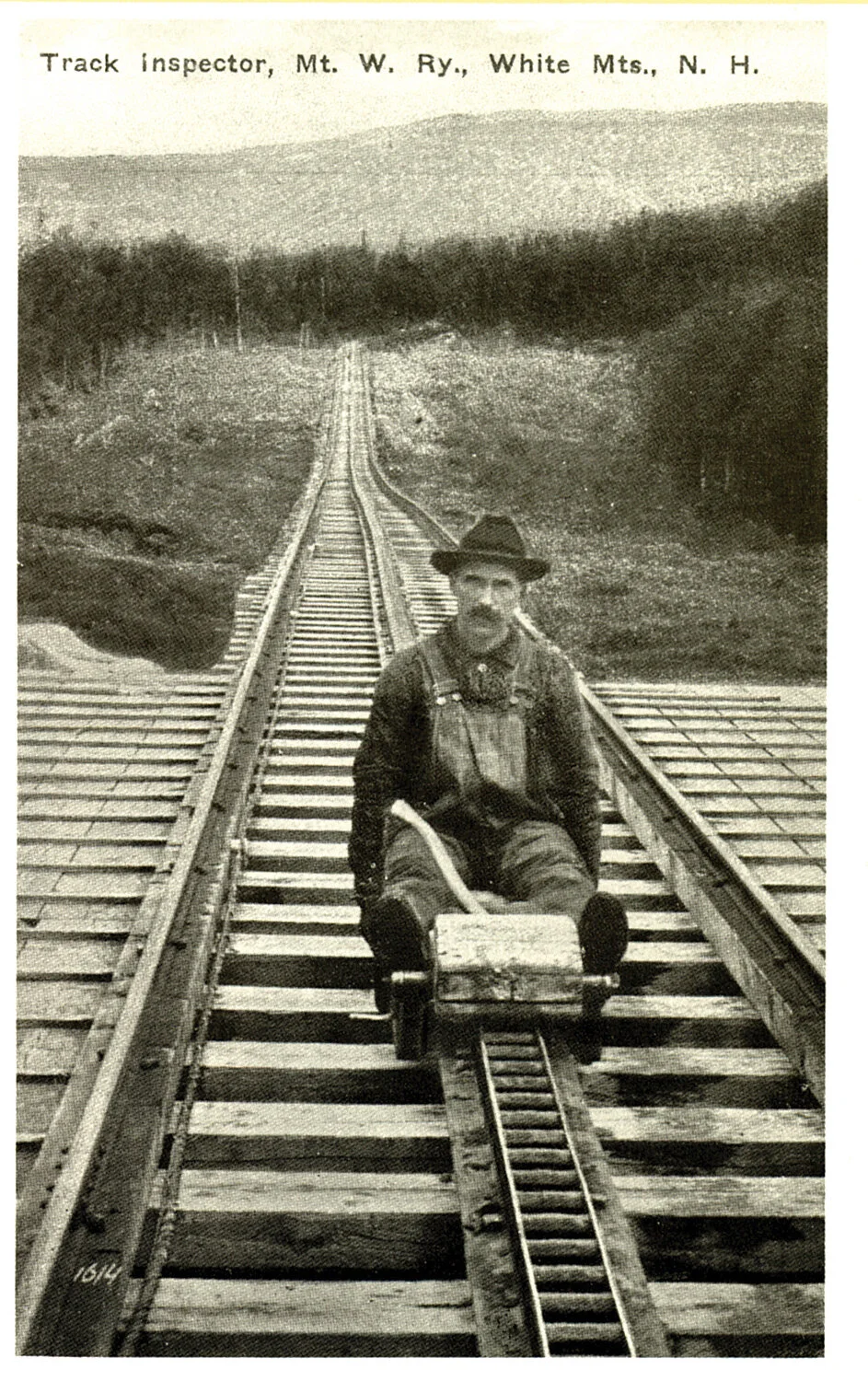
At the end of the long work day each evening, many track workers descended on slideboards known as Devil’s Shingles. Little more than a narrow plank of wood that rode on the center rack track, each homemade contraption was fitted with a seat, foot rests and hand brakes designed to grip the overhanging lip of the rack. The average trip from summit to base station took about 15 minutes, but boys being boys, competitive descents soon became common. The record time was 2 minutes 45 seconds at an average speed of 60 mph!
Eventually, however, the state of New Hampshire (the “live free or die” state) outlawed the use of the Devil’s Shingles, apparently because way too many workers were living free and dying on them!
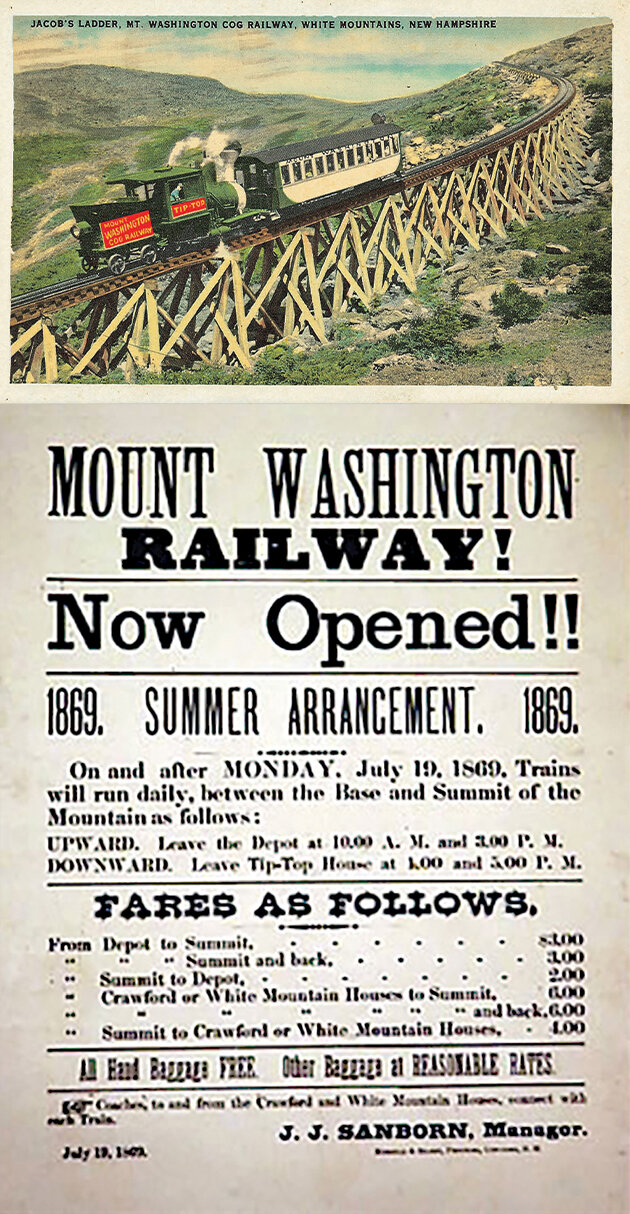
Aided by Peppersass and locomotive #2 “George Stephenson”, the process of building and installing over a thousand individual support structures (called “bents”) necessary to lay the track work above ground level progressed rapidly. By the summer of 1868, work crews had passed the halfway point and were approaching tree line, the region where the heavy forest gives way to a rocky sub arctic-tundra known as the summit cone.
On Mount Washington, tree line occurs at roughly 5000’, quite low compared to mountains in the west where tree lines can be twice as high. This is a consequence of the mountain’s unique geographic location at the juncture of three major weather fronts. The mountain acts as a force multiplier to weather systems coming from the northeast, south and west, giving it a well earned reputation for having some of the most severe conditions in the world.
Marsh’s chosen route closely followed a trail blazed nearly 50 years earlier by a young settler named Ethan Allen Crawford. At 4725’, track crews faced the daunting challenge of building a left-curving high trestle to span a boulder strewn gap. Crawford referred to this part of the mountain as “Jacob’s Ladder”, and the ambitious new structure would become its namesake.
After months of difficult, dangerous work, perhaps the most impressive feat of engineering on the entire railway was complete. At nearly 300’ long, 25’ above the surface of the mountain, and ascending at a 37.41% grade, it would eventually enter the record books as the steepest and second highest railroad trestle in the world, and by far the steepest portion of Marsh’s railway.
To this day, standing watch over it from a nearby knob is a boulder faintly inscribed with the initials EAC, the name Lucy and the year 1820. With it, Ethan Allen Crawford honored both his wife and his own trail blazing accomplishments in the Presidential Range. Completed that year across the ravine, the Crawford Path remains the oldest continuously maintained footpath in the United States. The following year, Crawford went on to blaze the route that would eventually become the Cog Railway.
With that obstacle conquered, Marsh held a formal opening celebration on August 14, 1868. Dignitaries left the train at Jacob’s Ladder and hiked the remaining distance to the Tip Top House for dinner, returning to the train for a sunset descent to Marshfield.
Regular passenger service to the trestle commenced thereafter, while higher up, track work continued toward the summit. The ambitious goal of completing the line before winter seemed within reach.
By mid October, tracks were laid to within a few hundred feet of the finish line, but winter weather forced the cessation of work for the year. The final stretch of track wouldn’t be complete until July 3 of the following year, with little additional fanfare.

And discussing it all with the conductor.

There were 360° views from the top and I took lots of photos because the mountains make great watercolor backgrounds.


You can see the cog train as it goes down the mountain. It gives you an idea of the scale.


And yes there was snow. Speaking of snow, our innkeeper on the last night of our Vermont hike said the week before they had snow and rain and freezing temps. The walkers were wearing gloves, hats and coats to walk. We’ve been really blessed with the weather.


It was a little bit chilly up there, 41°, 14 mph winds, and beautiful sunshine. Visibility was 100 miles.


Just to let you know a few of the mountain names surrounding us: Madison, Adams, Jefferson, Monroe, Franklin, Eisenhower, Pierce, Jackson, Webster
The Presidential Range in the White Mountains of New Hampshire is one of the most iconic mountain ranges in the United States. It comprises thirteen mountains, nine of which are over 4,000 feet in elevation, and seven of which are named after U.S. Presidents. One of the most challenging hikes in the White Mountains is the Presidential Traverse. It stretches 23 miles across the seven presidential 4,000-footer peaks and involves nearly 9,000 feet of elevation gain. But how and why were some of these peaks named after U.S. presidents? As it turns out, the names were assigned rather arbitrarily.
The first peak to be named was Mount Washington, though the exact date and the occasion of the naming remains unknown. The generally accepted theory is that the mountain was named by Reverend Manasseh Cutler sometime after his expedition to the peak with Reverend Jeremy Belknap in 1784. Belknap and Cutler were both prominent intellectuals at the time – Belknap was a Harvard graduate, minister, and historian who wrote the first history of the state of New Hampshire – and Cutler was a lawyer, minister, and early scientist, who was considered to be an innovative botanist. Though Belknap and Cutler were not the first to ascend Mount Washington, their expedition was the first well-documented climb in North America to gather information on natural history and measure the summit’s altitude. This trip was also one of the first times that scientists visited and observed a world above treeline in the United States.
The rest of the Presidential Peaks were named in a single day in 1820. The process for naming these peaks was simple. As Mount Washington was the tallest peak named after the first president, the next tallest peak was named for the second president, John Adams, and so on. After christening Mount Adams, Jefferson, Madison, and Monroe, the party ran out of presidents, but they still had two peaks remaining. They named one Mount Franklin, after Benjamin Franklin, and the other Mount Pleasant, though no one seems to know how this name came to be. Mount Pleasant was later renamed Mount Eisenhower by a vote of the New Hampshire legislature in 1969.
The rest of the peaks were not named after presidents. Mount Webster was named after Daniel Webster (a lawyer and U.S. Congressmen), Mount Jackson after Charles Thomas Jackson (a prominent geologist), Mount Sam Adams, after Samuel Adams (one of the Founding Fathers of the United States), and Mount Clay was named after Henry Clay (another U.S. Congressmen). There was an attempt by the New Hampshire State Legislature to rename Mount Clay to Mount Reagan in 2003, but the United States Geological Survey didn’t accept and it remains Mount Clay to this day.

New Hampshire is not named the “Granite State” for no reason. This is the Tip Top house mentioned in the Cog Railway story above.


And we are terrible at taking selfies.


Between the altitude and these steps, I was out of breath when I got up there.

We met a young girl from Norway who had just hiked all the way up the mountain from the bottom. It took her 3 1/2 hours to climb just over 3 miles, pretty much straight up.

Coming down the mountain now.


Very unusual (to me) moss.

You can see that only a few sparse trees still have color.

Drove across the Kancamagus Hwy on our way back to Manchester.
The Kancamagus Highway stretches across the White Mountains for 34.5 miles from Lincoln to Conway. This scenic road climbs to nearly 3,000 feet as it traverses the flank of Mt. Kancamagus at the height of land in Lincoln, and offers outstanding opportunities for distant mountain views, and native flora and fauna.
The Kancamagus Highway was dedicated as the first of the National Scenic Byways in the northeastern United States - for its recreational opportunities and aesthetic, cultural and historicvalues. The road is open year round.

After checking into the Country Inn at Manchester airport, we went to TBones for dinner. The hotel suggested it and gave us a coupon for a free appetizer.

I had Korean salmon rice bowl

Kim had the cheeseburger. They were voted best hamburger in New Hampshire. Kims pretty sure it wasn’t.
Well I’m off to bed and home tomorrow. Until next time…
What do they pay? That’s an old apparatus.
ReplyDeleteOh now it makes sense about that teeny train I saw in the distance. What a fascinating story and incredible accomplishment. I can’t imagine he wasn’t inspired and empowered by the Lord. The mountain pictures are just beautiful! The blue and purple hues just draw the viewer into their beauty. Thank you for taking us along on your journey and sharing your insights and glorious photos. Such a gift to us. ~Kody
ReplyDelete